Resilience Intelligence: What F1 Teams Teach Us About Thinking Differently
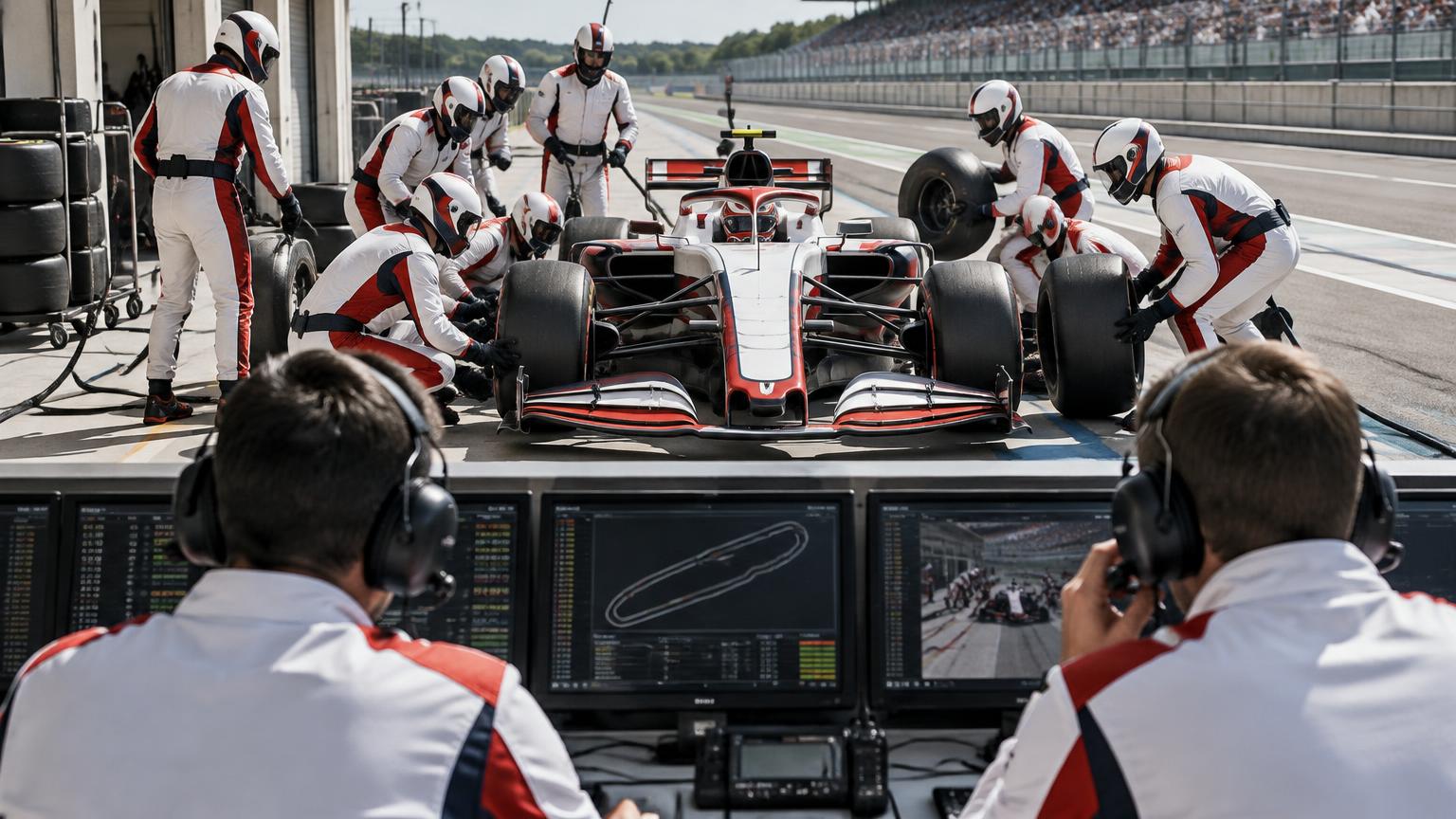
A fast car matters. But speed alone does not decide what a team should do when the race changes. That is where Resilience Intelligence begins: seeing differently, deciding deliberately and acting together before the opportunity disappears.
Watch an F1 race and the driver is the most visible part of the performance. Behind that driver sits a network of engineers, strategists, mechanics and specialists interpreting an evolving situation. Tyre behaviour, traffic, weather and competitors' decisions can change the value of a plan. The team must understand not only what is happening, but what it means for the next decision.
I am not an F1 engineer. I study the thinking behind elite-team decisions and what leaders can learn from it. For me, the lesson is not to make business feel like a race. It is to build a team that can question its assumptions without losing the ability to execute.
Resilience is not just recovery
Resilience is often described as bouncing back after something goes wrong. Resilience Intelligence asks an earlier question: can we recognise that conditions are changing, learn from the signals and adapt before our original plan becomes a liability? Recovery remains important. But an organisation that only gets good at recovery can become very efficient at repeating the same mistakes.
An F1 team cannot stop the race to hold a strategy workshop. It needs preparation, shared information and clear decision responsibilities already in place. The same is true for a business facing a supplier failure, a shift in customer demand or a competitor's unexpected move. Intelligence becomes valuable when it changes a decision, not when it fills another dashboard.
Outside-the-Box Thinking is disciplined, not random
Thinking differently does not mean ignoring evidence or taking a dramatic risk simply to look bold. It means challenging the frame around the problem. Instead of asking, ‘How do we execute our original strategy faster?’, a team asks, ‘Is that still the right strategy for the situation we now face?’
Consider a hypothetical race in which rain is approaching. Staying out may protect track position; changing tyres may offer an advantage if conditions deteriorate. Neither choice is automatically clever. The useful thinking compares scenarios, tests assumptions and recognises what would make the team change its mind. A different decision is only valuable when it is grounded in the situation.
The advantage is not simply thinking faster. It is noticing when the question needs to change.
Why it matters to F1 performance and success
Technical performance creates possibilities. Team intelligence determines how well those possibilities are used. A sound strategy can be weakened by slow communication or an uncoordinated pit stop. Equally, flawless execution cannot rescue every poor strategic choice. Success depends on connecting judgement and delivery.
- Seeing earlier: combine driver feedback, timing information and track conditions rather than treating one signal as the whole picture.
- Challenging assumptions: examine whether the expected tyre life, weather pattern or competitive response still holds.
- Deciding together: make room for specialist disagreement, then establish a clear decision and responsibility for acting on it.
- Executing reliably: rehearse familiar tasks so the team has capacity to respond when the situation becomes unfamiliar.
- Learning continuously: review the reasoning as well as the result. A good outcome can hide a weak decision; a poor outcome can follow a reasonable choice under uncertainty.
Thinking differently is therefore a contributor to performance, not a guarantee of victory. Car capability, driver skill, reliability, resources, regulations and circumstances still matter. The transferable lesson is that a team improves its chances when it can use evidence, challenge its thinking and coordinate its response.
Bring the loop into your business
Within REACT™, Adaptive Intelligence Loops connect sensing to learning and action. The Resilience Intelligence Loop — Sense, Learn, Adapt, Embed, Evolve — makes this a repeatable discipline rather than a one-off burst of creativity.
- Sense: what has changed in our customers, partners or operating environment?
- Learn: which assumption does that signal challenge, and what evidence are we missing?
- Adapt: what alternative can we test, who decides, and what limits the downside?
- Embed: what needs to change in our routines, responsibilities or shared knowledge?
- Evolve: how does this cycle leave us better prepared for the next decision?
A question for your next team meeting
Ask: ‘What would have to become true for our current plan to stop being the best option?’ Then invite someone to argue the alternative. Agree which signals you will monitor, who has authority to respond and when you will review the decision. You do not need an F1-sized operation to begin. You need permission to question the plan and enough discipline to turn the answer into action.
Outside-the-Box Thinking is not the opposite of preparation. It is one of preparation's most important outcomes. The aim is not to abandon your plan at the first disruption. It is to know when to hold it, when to change it and how to bring the team with you. That is Resilience Intelligence in practice.
These ideas sit at the heart of The Resilience Intelligence Blueprint™ and REACT™: building organisations that sense earlier, learn faster and turn disruption into direction. The book releases chapter by chapter on Substack — Chapter 1 is free; subsequent chapters are for paid subscribers.